Like the end of the oil-consuming era, the segment on energy is also coming to a close. Just to finish things up, I'm going to recap one or two things. (Not everything, as that would be terribly long and drawn out.)
Coal, Natural Gas, Oil - These are fossil fuels formed from organic matter buried within the ground. They provide sources of energy, but are also sources of CO2. While they are useful, it is essential that we move past these forms of energy to something cleaner and more efficient.
Nuclear - While potentially dangerous, nuclear power is a good backup. It provides constant energy, with little to no damage to the environment. Fission works right now, and fusion might at some point in the future. If nothing else, nuclear power is something to consider as a temporary replacement to oil and gas.
Hydrogen - While environmentally friendly, the technology for hydrogen isn't fully developed. If we can discover better methods of recovering elemental hydrogen, perhaps it might be a viable option. But that is millions of research dollars and years away.
Biofuel - One of the most controversial energy sources, in my mind. Renewable, to and extent. But production currently requires the burning of fossil fuels to produce the ethanol and bio diesel. And there's the issue of energy return: it's not 100%. Again, more research is needed. If we can improve the return ratio and reduce our reliance on fossil fuels to produce biofuel, it might just be one of the best options for the future.
What I have covered in these blogs are just the very tip of the iceberg, so to speak. There is so much more information out there. I encourage you to look further into the subject, to familiarize yourself with more of the scientific pros and cons of each topic. They are fascinating and absolutely essential to the continuation of our current way of life.
~Interminable Immediacy
Showing posts with label energy. Show all posts
Showing posts with label energy. Show all posts
Thursday, October 18, 2007

Wednesday, October 17, 2007
The Aftermath
So what consequences will we have to deal with, as a result of our energy issues? The book The Long Emergency, by James Howard Kunstler, addresses some of them. For one thing, suburbia is dead. People will need to live in the cities, with easier access to jobs, public transportation, etc. That, or we will revert back to a more rural society, with most people living in small communities where they grow their own food. According to Kunstler:
“The dirty secret of the American economy in the 1990’s was that is was no longer about anything except the creation of suburban sprawl and the furnishing, accessorizing and the financing of it. It resembled the efficiency of cancer. Nothing else really mattered except building suburban houses, trading away the mortgages, selling the multiple cars needed by the inhabitants, upgrading the roads into commercial strip highways with all the necessary shopping infrastructure, and moving vast supplies of merchandise made in China for next to nothing to fill up those houses”
But there is a positive side. For example, those living in urban environments can bike or walk, instead of driving cars. And, wonder of wonders, it might just improve our health while we're at it. And city planning will become essential. As some people will inevitably move into the city, space must be economized. And it must be done in a manner that doesn't call for a lot of automotive traffic. The better planned things are, the more individuals can rely on more pedestrian forms of transportation. This, of course, is the concept of the "sustainable city."
Steven Wheeler put forth this definition of the sustainable city in 1998: "[the sustainably city is one where it has] development that improves the long-term social and ecological health of cities and towns." His ideas for this covered several topics, from economic land use and waste reduction to the restoration of natural environments. He also mentioned good living conditions, sustainable economics, community participation, and preservation of local culture. This is an ongoing process, and not an easy one. Urban areas have to be safe, with a lack of "slums," with available forms of non-polluting/minimal pollution transportation, opportunities for urban renewal, and aesthetics. All of these must also be considered in the long term, with opportunities for change and adaptation.
I realize this post is rather short, but it's basically just getting you to think. Suburban sprawl is unsustainable. As oil becomes more expensive, gas prices will rise. Consequently, it limits our transportation options. Any ideas on what can be done? Or how we can improve on urban and regional planning?
Steven Wheeler put forth this definition of the sustainable city in 1998: "[the sustainably city is one where it has] development that improves the long-term social and ecological health of cities and towns." His ideas for this covered several topics, from economic land use and waste reduction to the restoration of natural environments. He also mentioned good living conditions, sustainable economics, community participation, and preservation of local culture. This is an ongoing process, and not an easy one. Urban areas have to be safe, with a lack of "slums," with available forms of non-polluting/minimal pollution transportation, opportunities for urban renewal, and aesthetics. All of these must also be considered in the long term, with opportunities for change and adaptation.
I realize this post is rather short, but it's basically just getting you to think. Suburban sprawl is unsustainable. As oil becomes more expensive, gas prices will rise. Consequently, it limits our transportation options. Any ideas on what can be done? Or how we can improve on urban and regional planning?
Tuesday, October 9, 2007
Black Gold
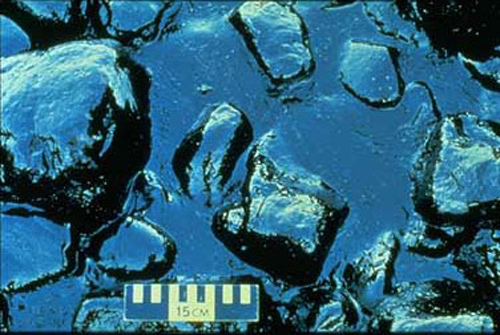 The one energy related issue I have not previously discussed is petroleum, gasoline, oil, black gold. Whatever you want to call it, it is the the main source of the problems we face today. Our economy is driven by oil (no pun intended). As reserves dwindle, we find ourselves on a slippery slope. Do we look the other way? Do we put time and resources into research? I have discussed the possible alternative energy sources. Now it's time to hit the crux of the matter.
As with the other fossil fuels, it is good to discuss the origins of oil. There are several conditions that need to be perfect or nearly perfect for oil to form:
1. Basins at the edges of the oceans must have a high concentration of organic material (5% or over) in their sedimentary rock. These conditions are extremely rare. If it weren't, there would be a lot more oil than there is currently.
2. The sediments have to be withing the oil window, 7500-15000ft. At 7500ft, the temperature causes large organic molecules to break down. Molecules with 5-20 carbon atoms are liquid at room temperature and pressure. Any less than 5 and the molecule is a gas at room temp and pressure.
3. Organic rick sediment buried below 15000ft will be "dry" natural gas, not oil.
4. About 90% of the oil finds its way to the surface via oil seeps. Only 10% gets trapped underground.
5. Porous rocks such as sandstone, limestone (CaCO3), and dolomite (CaMg(CO3)2) must be present to serve as reservoirs.
6. The pores in the host rock must be connected to each other, allowing for oil flow (permeability). The larger the pores in the rock, the more permeable it is. That being said, the permeability is the square of the grain size. Increasing the grain by 2 increases permeability by 4. And so on.
7. There must be a layer of rock above the oil reservoir that is relatively leak-proof. A few examples of such cap-stone rock types are fine-grained mudstone, halite (NaCl), and anhydrite (CaSO4).
Without even one of these factors, there will be no oil. The Middle East is prime oil country as the conditions there are just near perfect. As it stands, Saudi Arabia is the largest producer of oil in the world (7.7 million barrels/day with only 1600 working wells). The next largest produces are Russia (7.4 mil barrels/day, 41000 wells) and the United States (5.8 mil barrels/day, 521,000 wells).
 In the past, oil drilling was done by "banging a chisel up and down on the end of a rope." Eventually, drills were developed which operated using a heavy bit of wire with a drill bit attached to it. A thin mud flows back and forth in the drill pipe. However, other methods have been developed.
If you recall, a recent commercial depicted a "man with a problem." In one of the commercials, he was sitting in a shop with his son when the boy bent his straw to get the last bit of his drink from the bottom and sides of his glass. I'm sorry to say, but horizontal drilling is not a new invention. It has been around for years. But it is effective. It can turn a vertical well into a horizontal well. This can be effective for up to a half mile or more. "Diamond bits" are tungsten-carbide drill heads in which synthetic diamonds are embedded. The hardness of the diamond allows drilling to be done much more quickly, and can drill up to 7000ft. It saves costs, too, since the drilling doesn't have to stop to replace worn our drill bits.
Recently Boeing Corporation donated several powerful lasers to the Colorado School of Mines. This was done in hopes of finding even faster drilling methods. (It should be noted the lasers were from the abandoned Star Wars program.) Finally, some rigs use continuous drilling, unrolling pipe like fishing line.
When the oil well is initially breached, the oil and gas comes bubbling up because the pressure is not equal. However, it eventually dies down and pumpjacks are set up to bring the oil to the surface. Once the easily accessible oil is retrieved, secondary recovery is started. Early on, this was accomplished by flooding the well with water so that the lighter oil could be recovered. Unfortunately, most efforts only recovered about half of the available oil in the reservoir. But other methods have been developed. Carbon dioxide is one especially good method. It is extremely soluble in crude oil and it gets the oil moving again. The drawback? 100% of the reservoir oil isn't recoverable no matter what we do.
We can't forget the rising price of oil, either. As oil becomes more scarce, the price rises to balance drilling and exploration costs against consumer demand. The Organization of the Petroleum Exporting Countries (OPEC) was formed, in part, to help regulate the price of oil. OPEC no longer controls the price of oil. But, then, no one does.
Most oil is used for transportation (a fact mentioned in previous posts). But something needs to be done. Technology that doesn't rely on oil. Better city planning. More people carpooling or using public transportation. Thoughts?
Monday, October 8, 2007
Biodiesel?
I find it amusing that, in the course of my discussion on energy, the newest National Geographic comes out. What is the topic of this month's issue? Global warming and biodiesel. I have already covered global warming; to do so again would be to beat it with a stick. Instead, I shall focus on this newest topic. Fuel produced from crops such as soy beans, corn, and sugar cane. "Proponents say such renewable fuels could light a fire under our moribund rural economy, help extract us from our sticky dependence on the Middle East, and–best of all–cut our ballooning emissions of carbon dioxide."
Biodiesel: the miracle replacement for gasoline. Some cars can run completely on ethanol or biodiesel. But here's one of the major issues. Compared to a gallon of gasoline, ethanol has only 67% of the energy content. Biodiesel is better, but it is still only 86% compared to a gallon of diesel. How do we reconcile this lack? Well, one way to do so is to look at the environmental aspect of things. Since organic-based fuels use carbon that is in the ground, it is not putting extra CO2 into the atmosphere. In a manner of speaking, with the right technology and fuel efficiency, cars could become carbon neutral. Unfortunately, at current technology levels, "producing corn ethanol consumes just about as much fossil fuel as the ethanol itself replaces." Using all our crops to produce "grown fuel" would only replace approximately 6% of our diesel and gasoline consumption.
Despite this apparent disappointment however, there is a bright star. Brazil, producing diesel from sugarcane, has managed to curtail its reliance upon imported oil. The United States government has pledged nearly $200 million to research, hoping to be able to replace up to 15% of our oil reliance by 2017. But the key, overall, is to produce oil from sources other than foodstuffs. If we can manage that, we will be better off. We will still have enough food to feed our burgeoning population as well as keep out livestock fatted.
 The original car models ran on alcohol, but it was expensive and didn't provide nearly as much energy as conventional refined petroleum. But that has changed some, since the introduction of ethanol-gasoline fuel mixes. Methyl tertiary-butyl ether (MTBE) was the additive used by oil companies for the same purpose. However, when it began to show up in aquifers (underground layers of water-bearing porous rock from which water can be extracted via wells), its use was banned. It didn't help that MTBE was believed to be carcinogenic (a cause of cancer).
An extra benefit to the biodiesel/ethanol industry is the fact that it can jump-start small town economies. With farmers selling their crops, plants that produce these fuels create numerous job opportunities. The prices of corn and soybeans goes up, up to $4/bushel.
Again, there are issues. E85 (85% ethanol, 15% gasoline) "delivers 30 percent fewer miles a gallon than gasoline." And it can only be burned in specially designed engines. BUT! It is cheaper than regular gasoline. Its transport can be rather costly, but with plants springing up (ha!) all over the place, it should keep prices comparatively low.
Ethanol is alcohol. It is distilled through a process that hasn't much changed through the centuries. The grain is ground, then mixed with water and heated. Enzymes turn starch into sugar, then yeast is added. In the fermentation tanks, the yeast converts the sugar into alcohol. The alcohol is then separated from the water. What is left is fed to cows or spread over crops to be used as fertilizer. The drawback comes from the use of fossil fuels to heat the mixture, giving off carbon dioxide (which is also produced by the yeast). Some studies claim that ethanol is a losing battle, others make it to be more beneficial. Either way, it is not a cure-all solution. "Biofuels are a total waste and misleading us from getting at what we really need to do: conservation," says Cornell University's David Pimentel, who is one of ethanol's harshest critics. "This is a threat, not a service. Many people are seeing this as a boondoggle." However, proponents of ethanol, especially those who produce it, believe they can do things better. "They plan to fire their boilers with methane from two giant four-million-gallon biodigesters fed with cattle manure from the feedlot next door–in effect using biogas to make biofuel." (This amuses me, I should like to point out.)
Good and bad go hand-in-hand in the ethanol/biodiesel industry. But look again the the example of Brazil. When OPEC put an embargo on oil, Brazil turned to ethanol for fuel. It has done so again and most Brazilian cars haven't burned gasoline in years. Ethanol has a high octane rating (113) and burns better at higher compression. What is the secret to Brazilian success? Sugar cane! Yes, the same cane used to produce refined sugar for our tables. The plant is already %20 sugar and begins to ferment almost immediately after being cut, unlike corn which needs to convert starch to sugar. And it produces nearly twice as much ethanol as corn. The wastewater from the process, just like that from corn-based ethanol, can be used as fertilizer. And that is just how Brazilian producers use it. Another plus for the Brazilians is that they do not burn fossil fuels, but waste products. A final plus, researchers believe cane-based ethanol produces less carbon dioxide than gasoline (55-90%!) and the ethanol can be made from the stalks and leaves of the cane plant.
So, how do we respond? There are at least two other possible methods of creating biofuel: cellulose (from plant material) and algae (green algae, to be exact). There are pros and cons to each process, mainly in the department of research and development. However, the processes are out there and they are gaining notoriety and popularity. I say, if we can make biofuel work, let's go for it. Thoughts? Reactions?
Biodiesel: the miracle replacement for gasoline. Some cars can run completely on ethanol or biodiesel. But here's one of the major issues. Compared to a gallon of gasoline, ethanol has only 67% of the energy content. Biodiesel is better, but it is still only 86% compared to a gallon of diesel. How do we reconcile this lack? Well, one way to do so is to look at the environmental aspect of things. Since organic-based fuels use carbon that is in the ground, it is not putting extra CO2 into the atmosphere. In a manner of speaking, with the right technology and fuel efficiency, cars could become carbon neutral. Unfortunately, at current technology levels, "producing corn ethanol consumes just about as much fossil fuel as the ethanol itself replaces." Using all our crops to produce "grown fuel" would only replace approximately 6% of our diesel and gasoline consumption.
Despite this apparent disappointment however, there is a bright star. Brazil, producing diesel from sugarcane, has managed to curtail its reliance upon imported oil. The United States government has pledged nearly $200 million to research, hoping to be able to replace up to 15% of our oil reliance by 2017. But the key, overall, is to produce oil from sources other than foodstuffs. If we can manage that, we will be better off. We will still have enough food to feed our burgeoning population as well as keep out livestock fatted.
 The original car models ran on alcohol, but it was expensive and didn't provide nearly as much energy as conventional refined petroleum. But that has changed some, since the introduction of ethanol-gasoline fuel mixes. Methyl tertiary-butyl ether (MTBE) was the additive used by oil companies for the same purpose. However, when it began to show up in aquifers (underground layers of water-bearing porous rock from which water can be extracted via wells), its use was banned. It didn't help that MTBE was believed to be carcinogenic (a cause of cancer).
An extra benefit to the biodiesel/ethanol industry is the fact that it can jump-start small town economies. With farmers selling their crops, plants that produce these fuels create numerous job opportunities. The prices of corn and soybeans goes up, up to $4/bushel.
Again, there are issues. E85 (85% ethanol, 15% gasoline) "delivers 30 percent fewer miles a gallon than gasoline." And it can only be burned in specially designed engines. BUT! It is cheaper than regular gasoline. Its transport can be rather costly, but with plants springing up (ha!) all over the place, it should keep prices comparatively low.
Ethanol is alcohol. It is distilled through a process that hasn't much changed through the centuries. The grain is ground, then mixed with water and heated. Enzymes turn starch into sugar, then yeast is added. In the fermentation tanks, the yeast converts the sugar into alcohol. The alcohol is then separated from the water. What is left is fed to cows or spread over crops to be used as fertilizer. The drawback comes from the use of fossil fuels to heat the mixture, giving off carbon dioxide (which is also produced by the yeast). Some studies claim that ethanol is a losing battle, others make it to be more beneficial. Either way, it is not a cure-all solution. "Biofuels are a total waste and misleading us from getting at what we really need to do: conservation," says Cornell University's David Pimentel, who is one of ethanol's harshest critics. "This is a threat, not a service. Many people are seeing this as a boondoggle." However, proponents of ethanol, especially those who produce it, believe they can do things better. "They plan to fire their boilers with methane from two giant four-million-gallon biodigesters fed with cattle manure from the feedlot next door–in effect using biogas to make biofuel." (This amuses me, I should like to point out.)
Good and bad go hand-in-hand in the ethanol/biodiesel industry. But look again the the example of Brazil. When OPEC put an embargo on oil, Brazil turned to ethanol for fuel. It has done so again and most Brazilian cars haven't burned gasoline in years. Ethanol has a high octane rating (113) and burns better at higher compression. What is the secret to Brazilian success? Sugar cane! Yes, the same cane used to produce refined sugar for our tables. The plant is already %20 sugar and begins to ferment almost immediately after being cut, unlike corn which needs to convert starch to sugar. And it produces nearly twice as much ethanol as corn. The wastewater from the process, just like that from corn-based ethanol, can be used as fertilizer. And that is just how Brazilian producers use it. Another plus for the Brazilians is that they do not burn fossil fuels, but waste products. A final plus, researchers believe cane-based ethanol produces less carbon dioxide than gasoline (55-90%!) and the ethanol can be made from the stalks and leaves of the cane plant.
So, how do we respond? There are at least two other possible methods of creating biofuel: cellulose (from plant material) and algae (green algae, to be exact). There are pros and cons to each process, mainly in the department of research and development. However, the processes are out there and they are gaining notoriety and popularity. I say, if we can make biofuel work, let's go for it. Thoughts? Reactions?
Thursday, October 4, 2007
Hydrogen Miracle?
It has been speculated that hydrogen power might be the miracle cure for the world's energy problems. After all, it is the most abundant element. And the knowledge for using electricity to break apart water has been around since at least 1805, over two hundred years. So why do we still rely on fossil fuels?  The answer is simple: The miracle cure might not be so miraculous. There is a limit to the achievements of the hydrogen economy. What is the hydrogen economy? To put it simply, it is the hypothetical situation where automotive power is derived from reacting hydrogen with oxygen. The purpose of the hydrogen economy is to reduce carbon dioxide emissions from carbon-based fuels and to provide a replacement for dwindling petroleum reserves. This would make it a storage tool as opposed to nuclear fusion as a primary energy source.
We have to ask ourselves two questions, claims Kenneth Deffeyes. "Is hydrogen an effective solution to the problem?" and "Can we make an orderly transition from our present gasoline powered cars to a hydrogen fleet?" These can lead to two interesting problems. The first being a situation similar to that of ethanol. Ethanol, or corn oil, requires more energy input than that which is derived from the final product. If this is the case with hydrogen, then perhaps it is not so economical to utilize it as a fuel source.
The second issue is like that of natural gas powered vehicles. Is it a chicken and egg situation? Iceland has opened a hydrogen fueling station, but it is the only country to do so. Will other countries follow suit or will they wait until hydrogen cars are built? Will hydrogen cars be built if there are no filling stations? Governments can help the immediate situation by adding incentives if companies start producing and providing the necessary resources.
The biggest attraction of hydrogen energy is mobility. A large portion of petroleum is used for transportation. If we run out of petroleum, we lose a lot of transportation. But hydrogen can be used for a multitude of things. For example, according to a PBS article, Neah Power Systems in Seattle has developed a hydrogen battery which can provide power to laptops for up to 8 hours. If the technology advances, it could become efficient and powerful enough to power computers for far longer, or even to power automobiles. But most hydrogen today is used in making fertilizer and upgrading petroleum in refineries.
There are three ways of producing hydrogen known today. The first is known as the water-gas process. Put simply, it reacts methane (CH4) and steam (H2O) with a nickel catalyst at temperatures of 1500 °F. The end products are carbon dioxide (CO2) and hydrogen (H2).
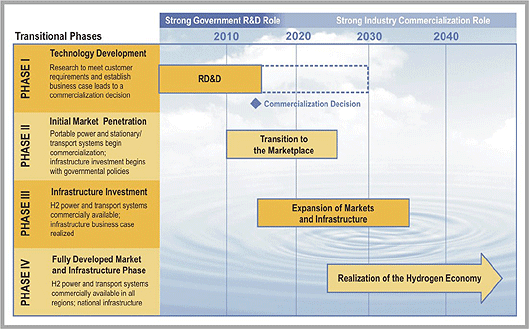 The answer is simple: The miracle cure might not be so miraculous. There is a limit to the achievements of the hydrogen economy. What is the hydrogen economy? To put it simply, it is the hypothetical situation where automotive power is derived from reacting hydrogen with oxygen. The purpose of the hydrogen economy is to reduce carbon dioxide emissions from carbon-based fuels and to provide a replacement for dwindling petroleum reserves. This would make it a storage tool as opposed to nuclear fusion as a primary energy source.
We have to ask ourselves two questions, claims Kenneth Deffeyes. "Is hydrogen an effective solution to the problem?" and "Can we make an orderly transition from our present gasoline powered cars to a hydrogen fleet?" These can lead to two interesting problems. The first being a situation similar to that of ethanol. Ethanol, or corn oil, requires more energy input than that which is derived from the final product. If this is the case with hydrogen, then perhaps it is not so economical to utilize it as a fuel source.
The second issue is like that of natural gas powered vehicles. Is it a chicken and egg situation? Iceland has opened a hydrogen fueling station, but it is the only country to do so. Will other countries follow suit or will they wait until hydrogen cars are built? Will hydrogen cars be built if there are no filling stations? Governments can help the immediate situation by adding incentives if companies start producing and providing the necessary resources.
The biggest attraction of hydrogen energy is mobility. A large portion of petroleum is used for transportation. If we run out of petroleum, we lose a lot of transportation. But hydrogen can be used for a multitude of things. For example, according to a PBS article, Neah Power Systems in Seattle has developed a hydrogen battery which can provide power to laptops for up to 8 hours. If the technology advances, it could become efficient and powerful enough to power computers for far longer, or even to power automobiles. But most hydrogen today is used in making fertilizer and upgrading petroleum in refineries.
There are three ways of producing hydrogen known today. The first is known as the water-gas process. Put simply, it reacts methane (CH4) and steam (H2O) with a nickel catalyst at temperatures of 1500 °F. The end products are carbon dioxide (CO2) and hydrogen (H2).
CH4 + 2 H2O = CO2 + 4 H2
Natural gas is the easiest way to produce this hydrogen, being composed mainly of methane. However, in the absence of natural gas, coal is another option. If natural gas is used, it would be an economic cycle. The natural gas from oil wells could be used to produce hydrogen. Then the carbon dioxide waste could be used to recover more oil.
 The second process is electrolysis. This method is accomplished by using electrolytic cells. These are cell which contain a cathode (positive) and anode (negative), using electrical voltage to separate ions. As with anything, however, there is a positive and negative side to producing hydrogen in this manner. The positive is that current (in amperes) produces hydrogen with over 98% efficiency. The downside, however, is that the voltage required is 20-30% greater than the ideal
What does this mean? Here's an example provided by Deffeyes in Beyond Oil. The most efficient commercial cells require 1.75-2.00 volts to produce hydrogen. The fuel cell only returns 0.7 volt. what does this mean? You only get back 40% of your overall volt input. But certainly we can develop a more efficient process! Theoretically, we can increase the efficiency by 30%, but the technology has stagnated. At the same time, solar and wind power can be used to produce hydrogen. However, these processes are not yet enough to compete with commercial electrolysis cells.
Finally, there are exotic hydrogen sources. Breaking down compounds which contain hydrogen works, but isn't done commercially. But the most interesting exotic source is purple bacteria. Instead of green chlorophyll, they have a different chemical compound which absorbs sunlight. Nothing is certain as of yet, but research in being conducted.
In the words of Nobel Prize-winning physicist Richard Smalley, "I believe it is the single most important problem facing humanity today: Energy. How are we going to get prosperous when oil and gas and coal are no longer enough?" The only way we can continue to prosper is by finding alternate sources of energy. Hydrogen is looking good, but there are definitely issues. If hydrogen power is to be completely non-polluting, the resources and methods used to produce it must also be non-polluting. There are also economic concerns about price. The final issues are, of course, storage and safety.
Hydrogen can be safely stored either as a pressurized gas or a cold liquid. Pressurized gas is stable, but large amounts of money are required to produce the necessary power. Liquid hydrogen, on the other hand, would require an insulated fuel cell and an escape route. With no escape route, the results could be... explosive. At current technological levels, liquid hydrogen is more efficient for consumption equivalent to 10 gallons of gasoline or greater. The major safety issue with hydrogen is that is burns. On its own, hydrogen gas isn't toxic if there is sufficient oxygen. But solutions of 4-75% hydrogen will burn. Hydrogen flames are nearly invisible and propagate at a rate of nearly 10ft/sec. Hydrogen can also undergo combustion in mixtures between 18-60% hydrogen. That mans absolutely no open flames near a hydrogen source unless it is very carefully controlled.
Overall, hydrogen seems like a good solution. But there are plenty of issues that need to be overcome before it is economically and commercially viable. So, what do we do? What are your thoughts on the matter?
 The second process is electrolysis. This method is accomplished by using electrolytic cells. These are cell which contain a cathode (positive) and anode (negative), using electrical voltage to separate ions. As with anything, however, there is a positive and negative side to producing hydrogen in this manner. The positive is that current (in amperes) produces hydrogen with over 98% efficiency. The downside, however, is that the voltage required is 20-30% greater than the ideal
What does this mean? Here's an example provided by Deffeyes in Beyond Oil. The most efficient commercial cells require 1.75-2.00 volts to produce hydrogen. The fuel cell only returns 0.7 volt. what does this mean? You only get back 40% of your overall volt input. But certainly we can develop a more efficient process! Theoretically, we can increase the efficiency by 30%, but the technology has stagnated. At the same time, solar and wind power can be used to produce hydrogen. However, these processes are not yet enough to compete with commercial electrolysis cells.
Finally, there are exotic hydrogen sources. Breaking down compounds which contain hydrogen works, but isn't done commercially. But the most interesting exotic source is purple bacteria. Instead of green chlorophyll, they have a different chemical compound which absorbs sunlight. Nothing is certain as of yet, but research in being conducted.
In the words of Nobel Prize-winning physicist Richard Smalley, "I believe it is the single most important problem facing humanity today: Energy. How are we going to get prosperous when oil and gas and coal are no longer enough?" The only way we can continue to prosper is by finding alternate sources of energy. Hydrogen is looking good, but there are definitely issues. If hydrogen power is to be completely non-polluting, the resources and methods used to produce it must also be non-polluting. There are also economic concerns about price. The final issues are, of course, storage and safety.
Hydrogen can be safely stored either as a pressurized gas or a cold liquid. Pressurized gas is stable, but large amounts of money are required to produce the necessary power. Liquid hydrogen, on the other hand, would require an insulated fuel cell and an escape route. With no escape route, the results could be... explosive. At current technological levels, liquid hydrogen is more efficient for consumption equivalent to 10 gallons of gasoline or greater. The major safety issue with hydrogen is that is burns. On its own, hydrogen gas isn't toxic if there is sufficient oxygen. But solutions of 4-75% hydrogen will burn. Hydrogen flames are nearly invisible and propagate at a rate of nearly 10ft/sec. Hydrogen can also undergo combustion in mixtures between 18-60% hydrogen. That mans absolutely no open flames near a hydrogen source unless it is very carefully controlled.
Overall, hydrogen seems like a good solution. But there are plenty of issues that need to be overcome before it is economically and commercially viable. So, what do we do? What are your thoughts on the matter?
Tuesday, October 2, 2007
Is it hot in here? Global warming's to blame!
One of the major concerns with fossil fuel energy is the emission of greenhouse gases. The issue with greenhouse gases is called global warming. It is a hotly contested issue. My goal is to discuss some of concerns, theories, and possible solutions to this problem.
Global warming is the increase in the average temperature of the Earth's near-surface air and oceans, both in recent decades and its projected continuity. In the last 100 years or so, the temperature has risen approximately 1.33 ± 0.32 °F. There is a high probability that a main factor for this increase is due to human activity, mainly the release of greenhouse gases into the atmosphere. Before 1950, volcanoes and solar variance might have played a minor role in warming the Earth. Post 1950, it is believed they may have had a cooling effect. The Intergovernmental Panel on Climate Change (IPCC) has studied models which predict a rise in temperature ranging from 2.0 - 11.5 °F between 1990 and 2100.
 Greenhouse gases, the culprits behind global warming, are divided into four categories. They are carbon dioxide (CO2), methane (CH4), nitrous oxide (N2O), and fluorinated gases. Carbon dioxide, methane, and nitrous oxide make up the largest segment of greenhouse gases in the atmosphere. A large percentage of these gases come from the burning of fossil fuels, the decomposition of matter, and other sources. These gases exist naturally. However, dangerous as they are, these are not the most powerful greenhouse gases. The fluorinated gases, like hydrofluorocarbons and perfluorocarbons, are powerful synthetic gases considered to be high global warming potential (GWP) gases. They are released during a number of industrial processes, such as the production of aluminum and magnesium, semiconductor manufacturing, and electric power transmission. In recent years, they have been used to replace various gases that deplete the ozone layer, like CFC's. Thankfully, despite their potency, they are released only in minor quantities.
 Major industrial countries burning coal for power tend to produce more greenhouse gases than less industrialized countries. However, there are several theories concerning the buildup of these gases, as well as theories concerning the warming of the Earth. One of the major theories is that the warming of the planet is completely natural, since we are coming out of the "Little Ice Age." Proponents of this theory believe the warming is a part of the natural temperature variation, that is has an established trend, and need not be explained by outside sources. While some of this might be true, the existence of greenhouse gases in the atmosphere cannot be ignored.
 Another theory concerning global warming is based on deforestation. As any botanist knows, trees and other plants utilize CO2 as a part of their respiration. A byproduct of this process is oxygen, which is released back into the atmosphere. The process of photosynthesis carried out by plants is essential to reducing the CO2 concentration. However, with more and more forest being cleared for farmland, especially in the tropics, there are fewer trees to leech carbon dioxide from the atmosphere. This reduction in the number of trees is thought to have led, in part, to the increased concentration of carbon dioxide. It should be noted, as well, that the oceans play a part in removing CO2 by absorbing it. The process is balanced between natural CO2 production and the amount of the gas the ocean can absorb. But with humans pumping large amounts of greenhouse gases into the atmosphere, the oceans cannot keep up with the increased percentage.
And yet, in some ways, global warming can be positive. Oddly enough, parts of the northern hemisphere have shown a certain amount of increased productivity. Despite this, the productivity is believe to be of finite proportions. Another possible benefit could be the emergence of the fabled Northwest Passage, which could cut thousands of nautical miles off voyages from Europe to Asia. However, the detriments appear to largely overpower the few possible benefits. For example, the rise in temperature is affecting various ecosystems. In the affected ecosystems, animal habitats are also being altered. At some point, these habitats may changed sufficiently that they are no longer suitable to the organisms which reside there. In that case, they will either die out or be forced to migrate to habitats more similar to their original one. One final possible effect of global warming is the spread of disease. It has been hypothesized that the increased temperatures have been expedient to the spread of diseases. At this point, though, that is just speculation as no-one is certain that this is true.
Finally, what can be done to help the situation? Some countries have put a tax on carbon, hoping to prompt companies to utilize less of the element, thereby producing less CO2. Other legal actions have been taken to reduce the output of greenhouse gases into the atmosphere. For example, in the United States, regulation of gas emissions have been given to the Environmental Protection Agency (EPA), under the Clean Air Act. The Clean Air Act is designed to help reduce air pollution. One way to achieve this is the use of renewable energy sources, such as wind, hyrdo, and solar power. While not available in all areas, wind and hydroelectric power plants can help. With more efficient absorption and storage, solar power can be extremely economical. Problems might occur on cloudy days, but those can be bypassed by storing electrical power.
The use of Energy Star appliances and turning them off while they're not in use can also reduce the production of greenhouse gases. This is a rather roundabout method, as the less electricity used mean less power needs to be generated. The purchase and use of more efficient, less polluting cars is another way to reduce emissions. Better sources of energy and transport will be developed in the future, but this is the now. Do you have any other suggestions or comments?
(For articles concerning global warming check out the New York Times science page.)
Global warming is the increase in the average temperature of the Earth's near-surface air and oceans, both in recent decades and its projected continuity. In the last 100 years or so, the temperature has risen approximately 1.33 ± 0.32 °F. There is a high probability that a main factor for this increase is due to human activity, mainly the release of greenhouse gases into the atmosphere. Before 1950, volcanoes and solar variance might have played a minor role in warming the Earth. Post 1950, it is believed they may have had a cooling effect. The Intergovernmental Panel on Climate Change (IPCC) has studied models which predict a rise in temperature ranging from 2.0 - 11.5 °F between 1990 and 2100.
 Greenhouse gases, the culprits behind global warming, are divided into four categories. They are carbon dioxide (CO2), methane (CH4), nitrous oxide (N2O), and fluorinated gases. Carbon dioxide, methane, and nitrous oxide make up the largest segment of greenhouse gases in the atmosphere. A large percentage of these gases come from the burning of fossil fuels, the decomposition of matter, and other sources. These gases exist naturally. However, dangerous as they are, these are not the most powerful greenhouse gases. The fluorinated gases, like hydrofluorocarbons and perfluorocarbons, are powerful synthetic gases considered to be high global warming potential (GWP) gases. They are released during a number of industrial processes, such as the production of aluminum and magnesium, semiconductor manufacturing, and electric power transmission. In recent years, they have been used to replace various gases that deplete the ozone layer, like CFC's. Thankfully, despite their potency, they are released only in minor quantities.
 Major industrial countries burning coal for power tend to produce more greenhouse gases than less industrialized countries. However, there are several theories concerning the buildup of these gases, as well as theories concerning the warming of the Earth. One of the major theories is that the warming of the planet is completely natural, since we are coming out of the "Little Ice Age." Proponents of this theory believe the warming is a part of the natural temperature variation, that is has an established trend, and need not be explained by outside sources. While some of this might be true, the existence of greenhouse gases in the atmosphere cannot be ignored.
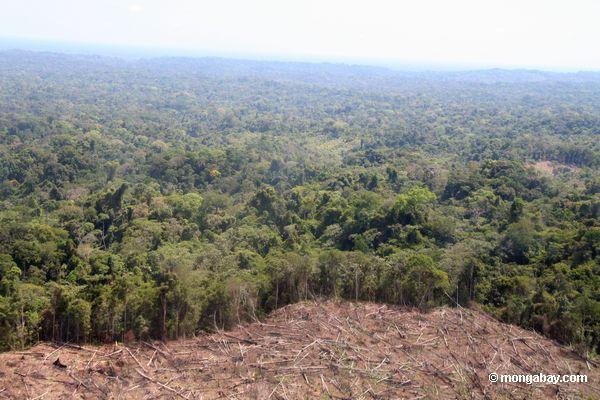 Another theory concerning global warming is based on deforestation. As any botanist knows, trees and other plants utilize CO2 as a part of their respiration. A byproduct of this process is oxygen, which is released back into the atmosphere. The process of photosynthesis carried out by plants is essential to reducing the CO2 concentration. However, with more and more forest being cleared for farmland, especially in the tropics, there are fewer trees to leech carbon dioxide from the atmosphere. This reduction in the number of trees is thought to have led, in part, to the increased concentration of carbon dioxide. It should be noted, as well, that the oceans play a part in removing CO2 by absorbing it. The process is balanced between natural CO2 production and the amount of the gas the ocean can absorb. But with humans pumping large amounts of greenhouse gases into the atmosphere, the oceans cannot keep up with the increased percentage.
And yet, in some ways, global warming can be positive. Oddly enough, parts of the northern hemisphere have shown a certain amount of increased productivity. Despite this, the productivity is believe to be of finite proportions. Another possible benefit could be the emergence of the fabled Northwest Passage, which could cut thousands of nautical miles off voyages from Europe to Asia. However, the detriments appear to largely overpower the few possible benefits. For example, the rise in temperature is affecting various ecosystems. In the affected ecosystems, animal habitats are also being altered. At some point, these habitats may changed sufficiently that they are no longer suitable to the organisms which reside there. In that case, they will either die out or be forced to migrate to habitats more similar to their original one. One final possible effect of global warming is the spread of disease. It has been hypothesized that the increased temperatures have been expedient to the spread of diseases. At this point, though, that is just speculation as no-one is certain that this is true.
Finally, what can be done to help the situation? Some countries have put a tax on carbon, hoping to prompt companies to utilize less of the element, thereby producing less CO2. Other legal actions have been taken to reduce the output of greenhouse gases into the atmosphere. For example, in the United States, regulation of gas emissions have been given to the Environmental Protection Agency (EPA), under the Clean Air Act. The Clean Air Act is designed to help reduce air pollution. One way to achieve this is the use of renewable energy sources, such as wind, hyrdo, and solar power. While not available in all areas, wind and hydroelectric power plants can help. With more efficient absorption and storage, solar power can be extremely economical. Problems might occur on cloudy days, but those can be bypassed by storing electrical power.
The use of Energy Star appliances and turning them off while they're not in use can also reduce the production of greenhouse gases. This is a rather roundabout method, as the less electricity used mean less power needs to be generated. The purchase and use of more efficient, less polluting cars is another way to reduce emissions. Better sources of energy and transport will be developed in the future, but this is the now. Do you have any other suggestions or comments?
(For articles concerning global warming check out the New York Times science page.)
Wednesday, September 26, 2007
Black Power: The Force of Coal
In the third installment of the power series, the topic is coal. I will briefly describe the origin of coal and a couple common types. I shall then go into the uses of coal. Finally, I will discuss the problems associated with the material. As with the discussion of natural gas, my main source for this article is the book Beyond Oil.
 (Coal)Coal, like other fossil fuels, is formed from organic materials. However, unlike oil and gas, which form from the decomposition of said materials, coal is formed in an entirely different manner. Coal was formed mainly during was has been termed the "Carboniferous period," which was approximately 280-310 million years ago. However, there are coal beds that are both younger and older than the Carboniferous period.
Basically, the period was a cycle of flooding as the glaciers would melt and the sea level would rise. The rise in sea level would bury bogs and swamps, areas of significant botanical accumulation. Layers of soil and fossils would be deposited on top of the area and "baked" (for lack of a better term). The materials used in coal production, not just the temperature, helped determine the type of coal that resulted. For example, spores and pollen produce a type of coal that burns easily and leaves very little ash (cannel coal). Jet, on the other hand, is a product of wood, and is usually glossy black. It can be used in jewelry.
 Coal is further categorized by age. It ranges from liginte (jet) to bituminous to anthracite. Each new category has a greater percentage of carbon. Anthracite, the last of the line, is over 90% carbon. It can be ignited for use in industrial heating. The most commonly used coal, however, is bituminous. It is used both for producing electricity and something called coke. Coke is treated coal burned in large ovens to produce charred lumps.
The byproducts of coke can be used for various industries. For example, the gases can be burned for light and heat. Others of the gases can be used as catalysts for other reactions which produce iron from ore. "Coal oils" (hydrocarbons) can be used in lamps. Most interestingly, the tars produced have lead to vibrant synthetic dyes.
The main use for coal, however, is in the generation of electricity. Coal is burned to heat water. The steam created is then used to turn turbines which create electric current. However, this is a major problem with the use of coal. Most coal is impure, containing amounts of sulfur and mercury. Since coal is a hard material, it is difficult to remove the impurities in that form. And while the smoke can be scrubbed, but it is still difficult. Since the main byproduct of burned coal is CO2, that creates a problem with "greenhouse gases." Despite these problems, there are a lot of coal burning plants in the United States. Another major issue with coal burning is sulfur dioxide (SO2). In the atmosphere, sulfur dioxide becomes sulfuric acid. That, in turn, becomes a contributor to acid rain and smog. Other coal issues include mercury pollution, underground mind drainage, and major surface disruptions caused by open-pit mines.
 Despite this, coal is the best source of energy. It is the cheapest per unit of energy. It is also quite an industry. The US is one of the major producers of coal worldwide. There are over 6000 coal mines in the US alone. The former Soviet Union is also a major producer of coal. And coal reserves are large enough that, at the rate it is being mined, production should be able to continue for a few hundred years.
So, the problem is, do we continue using coal? Do we continue burning coal, producing greenhouse gases and acid rain? Or do we look for alternate sources of energy, which is inevitable anyway?
 (Coal)
Basically, the period was a cycle of flooding as the glaciers would melt and the sea level would rise. The rise in sea level would bury bogs and swamps, areas of significant botanical accumulation. Layers of soil and fossils would be deposited on top of the area and "baked" (for lack of a better term). The materials used in coal production, not just the temperature, helped determine the type of coal that resulted. For example, spores and pollen produce a type of coal that burns easily and leaves very little ash (cannel coal). Jet, on the other hand, is a product of wood, and is usually glossy black. It can be used in jewelry.
 Coal is further categorized by age. It ranges from liginte (jet) to bituminous to anthracite. Each new category has a greater percentage of carbon. Anthracite, the last of the line, is over 90% carbon. It can be ignited for use in industrial heating. The most commonly used coal, however, is bituminous. It is used both for producing electricity and something called coke. Coke is treated coal burned in large ovens to produce charred lumps.
The byproducts of coke can be used for various industries. For example, the gases can be burned for light and heat. Others of the gases can be used as catalysts for other reactions which produce iron from ore. "Coal oils" (hydrocarbons) can be used in lamps. Most interestingly, the tars produced have lead to vibrant synthetic dyes.
The main use for coal, however, is in the generation of electricity. Coal is burned to heat water. The steam created is then used to turn turbines which create electric current. However, this is a major problem with the use of coal. Most coal is impure, containing amounts of sulfur and mercury. Since coal is a hard material, it is difficult to remove the impurities in that form. And while the smoke can be scrubbed, but it is still difficult. Since the main byproduct of burned coal is CO2, that creates a problem with "greenhouse gases." Despite these problems, there are a lot of coal burning plants in the United States. Another major issue with coal burning is sulfur dioxide (SO2). In the atmosphere, sulfur dioxide becomes sulfuric acid. That, in turn, becomes a contributor to acid rain and smog. Other coal issues include mercury pollution, underground mind drainage, and major surface disruptions caused by open-pit mines.
 Despite this, coal is the best source of energy. It is the cheapest per unit of energy. It is also quite an industry. The US is one of the major producers of coal worldwide. There are over 6000 coal mines in the US alone. The former Soviet Union is also a major producer of coal. And coal reserves are large enough that, at the rate it is being mined, production should be able to continue for a few hundred years.
So, the problem is, do we continue using coal? Do we continue burning coal, producing greenhouse gases and acid rain? Or do we look for alternate sources of energy, which is inevitable anyway?
Tuesday, September 25, 2007
Have gas? We do!
This is the second of the series of energy related blogs. In this post I will discuss natural gas. My main reference for this post is Kenneth S. Deffeyes' Beyond Oil.
A few things should be noted about natural gas:
1. It is produced from the decay of organic material in the absence of air.
2. It is mainly methane, but contains quantities of ethane, butane, propane, nitrogen, and helium.
3. It can be mined for a profit from rock that isn't easily permeable by oil.
Natural gas comes from two sources, "conventional" and "unconventional." Conventional gas comes from standard sources, generally mining of some form or another. Unconventional gas comes from other sources, such as swamp gas or coal beds.
Conventional gas production comes in three varieties. Solution gas is dissolved in oil and comes out of solution when the pressure drops. Basically, when the oil pocket is breached, the gas held in solution separates. A useful analogy would be carbonated beverages. Mining the oil in such pockets is not terribly profitable, but the games comes free. Production of natural gas from these types of mines previously kept gas prices down.
Gas caps form above oil reservoirs when there is more gas than the oil can dissolve. Miners can choose to get the oil first, leaving the gas for later production. Mining from such pockets is more effective at recovering larger percentages of oil, as well. As opposed to the 20-40% from solution gas, mining from gas caps recovers up to 50% of the oil contained therein.
The final conventional production is gas found below the depth where oil is located. Oil is found between 7500-15000 feet. Below that, oil deposits are quite rare. These pockets of gas are very good money makers for miners seeking the fossil fuel.
Unconventional gas production comes from four sources: swamp gas, coal bed gas, basin-center gas, and fractured shales. Swamp gas, as it is called, it produced by a bacteria which converts organic matter into methane gas. This would be the same bacteria which resides in the digestive tract. Some pockets of swamp gas can be commercially viable, but have no attracted the attention of major companies. However, since it is relatively easy to access, such deposits are quite rewarding for smaller countries.
Coal bed gas comes from the coal itself. As the coal is natural material, the decomposition of it produces the natural gas. However, the only reason such deposits exist is the sheer size of the plant matter used in the production of coal. Despite this, coal beds have managed to produce nearly 8% of the United States natural gas production.
Basin center gas is that which has completely permeated the host rock. However, this is not as viable a source of gas as, say, the coal beds. The natural gas is much harder to get and there never seems to be enough to completely saturate less-porous host rocks. By the same token, fractured shale gas can be equally as difficult to come by. More porous rocks like sandstone can become more saturated. However, the fractures in the rock produce wells that can be tapped slowly.
The use of natural gas is nothing new. Homes have stoves that use natural gas. Grills burn propane, a form of liquefied natural gas. Natural gas is also the third largest product used for the generation of electricity, after coal and nuclear power. Overall, it generates just over 600 kilowatt-hours of energy annually in the United States. But natural gas is also used for heating and industrial use. A portion of it also goes to make fertilizers because of the hydrogen that can be produced from natural gas. Since it has come to be used, in large part, for the production of electricity, the reserves of natural gas have been severely depleted.
Another interesting use for natural gas is in the automobile industry. The technology exists to use natural gas as fuel, instead of oil. Overall, these cars would use less than the equivalent of ten gallons of oil. A couple other benefits exist, such as the production of less carbon-dioxide and a high octane rating. (This basically means that it much reach a relatively high temperature before it spontaneously ignites.) However, the gas must be contained under high pressure. That also leads to another issue, that of refueling. The number of refueling stations for natural gas-run vehicles is scant, to say the least. They require specialized equipment, because of the high pressures. But this, in turn, exacerbates the problem. Deffeyes says, "individuals will not buy natural gas-powered vehicles because there are no filling stations; filling stations don't exist because nobody own natural gas powered vehicles" (Deffeyes 58).
As you can see, natural gas has its uses. It heats our homes and office buildings. It produces electricity for our gadgets. It can even be used to run our cars. However, reserves are dropping worldwide. Eventually, we will run out of easily accessable reserves and will need to find other methods to produce natural gas. Whether we will turn to the "unconventional" methods is yet to be known.
Do you have any thoughts on the matter? Is there an alternative for natural gas? Should we be reducing our reliance on this particular fossil fuel? Or should we simply continue as we have been?
A few things should be noted about natural gas:
1. It is produced from the decay of organic material in the absence of air.
2. It is mainly methane, but contains quantities of ethane, butane, propane, nitrogen, and helium.
3. It can be mined for a profit from rock that isn't easily permeable by oil.
Natural gas comes from two sources, "conventional" and "unconventional." Conventional gas comes from standard sources, generally mining of some form or another. Unconventional gas comes from other sources, such as swamp gas or coal beds.
Conventional gas production comes in three varieties. Solution gas is dissolved in oil and comes out of solution when the pressure drops. Basically, when the oil pocket is breached, the gas held in solution separates. A useful analogy would be carbonated beverages. Mining the oil in such pockets is not terribly profitable, but the games comes free. Production of natural gas from these types of mines previously kept gas prices down.
Gas caps form above oil reservoirs when there is more gas than the oil can dissolve. Miners can choose to get the oil first, leaving the gas for later production. Mining from such pockets is more effective at recovering larger percentages of oil, as well. As opposed to the 20-40% from solution gas, mining from gas caps recovers up to 50% of the oil contained therein.
The final conventional production is gas found below the depth where oil is located. Oil is found between 7500-15000 feet. Below that, oil deposits are quite rare. These pockets of gas are very good money makers for miners seeking the fossil fuel.
Unconventional gas production comes from four sources: swamp gas, coal bed gas, basin-center gas, and fractured shales. Swamp gas, as it is called, it produced by a bacteria which converts organic matter into methane gas. This would be the same bacteria which resides in the digestive tract. Some pockets of swamp gas can be commercially viable, but have no attracted the attention of major companies. However, since it is relatively easy to access, such deposits are quite rewarding for smaller countries.
Coal bed gas comes from the coal itself. As the coal is natural material, the decomposition of it produces the natural gas. However, the only reason such deposits exist is the sheer size of the plant matter used in the production of coal. Despite this, coal beds have managed to produce nearly 8% of the United States natural gas production.
Basin center gas is that which has completely permeated the host rock. However, this is not as viable a source of gas as, say, the coal beds. The natural gas is much harder to get and there never seems to be enough to completely saturate less-porous host rocks. By the same token, fractured shale gas can be equally as difficult to come by. More porous rocks like sandstone can become more saturated. However, the fractures in the rock produce wells that can be tapped slowly.
The use of natural gas is nothing new. Homes have stoves that use natural gas. Grills burn propane, a form of liquefied natural gas. Natural gas is also the third largest product used for the generation of electricity, after coal and nuclear power. Overall, it generates just over 600 kilowatt-hours of energy annually in the United States. But natural gas is also used for heating and industrial use. A portion of it also goes to make fertilizers because of the hydrogen that can be produced from natural gas. Since it has come to be used, in large part, for the production of electricity, the reserves of natural gas have been severely depleted.
Another interesting use for natural gas is in the automobile industry. The technology exists to use natural gas as fuel, instead of oil. Overall, these cars would use less than the equivalent of ten gallons of oil. A couple other benefits exist, such as the production of less carbon-dioxide and a high octane rating. (This basically means that it much reach a relatively high temperature before it spontaneously ignites.) However, the gas must be contained under high pressure. That also leads to another issue, that of refueling. The number of refueling stations for natural gas-run vehicles is scant, to say the least. They require specialized equipment, because of the high pressures. But this, in turn, exacerbates the problem. Deffeyes says, "individuals will not buy natural gas-powered vehicles because there are no filling stations; filling stations don't exist because nobody own natural gas powered vehicles" (Deffeyes 58).
As you can see, natural gas has its uses. It heats our homes and office buildings. It produces electricity for our gadgets. It can even be used to run our cars. However, reserves are dropping worldwide. Eventually, we will run out of easily accessable reserves and will need to find other methods to produce natural gas. Whether we will turn to the "unconventional" methods is yet to be known.
Do you have any thoughts on the matter? Is there an alternative for natural gas? Should we be reducing our reliance on this particular fossil fuel? Or should we simply continue as we have been?
Thursday, September 20, 2007
The Explosive Past and Productive Present - Nuclear Power
I have decided to do a small series or posts about energy. This includes energy sources as well as energy issues. This first post will cover nuclear power. I intend to discuss the benefits of nuclear energy, as well as one or two reactor types. For that, I will contrast the common pressurized water reactor to the "reactor cooled by water and moderated by graphite" (RBMK) reactor used for the Chernobyl reactor.
Chernobyl. The name sends shivers down the spines of any who know about what happened there. Chernobyl. A nuclear power station in the Ukraine whose #4 reactor exploded, releasing nuclear fallout over a wide swath of land. It is over 20 years since the explosion and there are still issues with radioactivity. This catastrophe is, perhaps, the paradigm of what can go wrong with nuclear reactors. It might even be enough to turn someone off the idea of nuclear power completely. However, as horrific as the Chernobyl incident was, the reactor used was poorly designed.
All nuclear reactors use particles, such as neutrons, to bombard fuel cells, such as Uranium. The effect of this process is the splitting of the target atom, releasing energy and neutrons. It is a chain reaction. Some of the energy released is radiation, in the form of heat. In order to ensure the continued production of energy, all reactors use a sort of buffer, which slows down the neutron sufficiently that it has a greater chance of hitting the target atom(s). In most American and Canadian reactors, this is water. The RBMK reactor used carbon in the form of graphite. (Reactor Design)
 The design technology of the RBMK reactor was nearly 45 years outdated. It was, in fact, the same technology used by Enrico Fermi in 1942. As such, there were two major design flaws. The first was the carbon used as a moderator.
It does not stand up well under high pressures. Not only that, it burns in the core when exposed to air. The burning increases the speed of the neutrons, creating even more heat. To prevent this from happened, air had to be kept out of the reactor core. The second major problem with the RBMK design was its decided lack of containment. There
was a seal designed to keep pressure in, but nothing to protect and shield in the case of an explosion.
 Modern nuclear reactors, such as those used in America and Canada, are much safer than the RBMK design. Both designs are pressurized water reactors (PWRs). Instead of graphite, they use water to moderate the reaction speed and efficiency. They work via a double coolant system. The water in the primary coolant system, around the core, is pressurized so that it can remain liquid above its natural boiling point. In US reactors, ordinary water is used. On the other hand, Canadian reactors use heavy water (water that contains deuterium), which is a slightly more effective moderator.
The secondary coolant system uses the heat from the primary system to turn the water flowing through the pipes into steam. That steam is then used to rotate a turbine, producing electricity in a generator. The water is then run over a condenser, returning it to a liquid state so that the process may be repeated. The only water in the system which is irradiated is that in the primary coolant system. Water used in the secondary system does not come in any direct contact with the radioactive water. Additionally, each reactor is surrounded by a steel-reinforced concrete container. This is a safety measure designed to contain the escape of radiation in the event of an accident. It is the last of a line of defenses meant to protect and reduce radioactive fallout.
Of course, it goes without saying that even the safest reactor has the possibility of malfunctioning. So, then, the question is, why even consider nuclear power? What are the benefits of it, if there are any? Well, for one, they are more environmentally friendly that coal burning power plants. Additionally, the 103 nuclear plants have consistently produced about 20% of our power output for the past decade. According to a National Geographic article, the problem with cheaper coal plants "is the two billion tons of climate-warming carbon dioxide spewing skyward every year... The Nuclear Energy Institute estimates that without nuclear power playing its current role in the generation of electricity, the U.S. would spew 29 percent—190 million metric tons—more carbon than it does now."
Aside from being more environmentally friendly, reactor technology is always advancing. In a few years, designs could lead to reactors that work more efficiently at higher temperatures. Such "intense nuclear reactions at such temperatures would leave waste that, compared to today's, is less toxic and lasts for a shorter period of time." In the long run, this means storage of these materials could be handled more easily. Not only that, the fuel would not be nearly as useful to terrorist groups looking to steal it.
Other countries use nuclear power. France, for example, derives nearly 80% of her electricity from nuclear power plants. Despite China's race to build coal plants, it also has designs for several nuclear plants. India, a nation with a massive population, has a significant number of reactors, with several more that are being built. In the US, a poll found that 59% of the population is in favor of nuclear power. But what about other, less dangerous, less expensive, forms of power?
~Interminable Immediacy
Chernobyl. The name sends shivers down the spines of any who know about what happened there. Chernobyl. A nuclear power station in the Ukraine whose #4 reactor exploded, releasing nuclear fallout over a wide swath of land. It is over 20 years since the explosion and there are still issues with radioactivity. This catastrophe is, perhaps, the paradigm of what can go wrong with nuclear reactors. It might even be enough to turn someone off the idea of nuclear power completely. However, as horrific as the Chernobyl incident was, the reactor used was poorly designed.
All nuclear reactors use particles, such as neutrons, to bombard fuel cells, such as Uranium. The effect of this process is the splitting of the target atom, releasing energy and neutrons. It is a chain reaction. Some of the energy released is radiation, in the form of heat. In order to ensure the continued production of energy, all reactors use a sort of buffer, which slows down the neutron sufficiently that it has a greater chance of hitting the target atom(s). In most American and Canadian reactors, this is water. The RBMK reactor used carbon in the form of graphite. (Reactor Design)
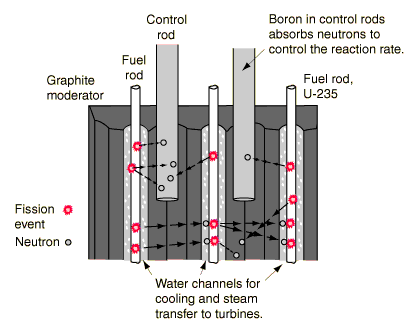 The design technology of the RBMK reactor was nearly 45 years outdated. It was, in fact, the same technology used by Enrico Fermi in 1942. As such, there were two major design flaws. The first was the carbon used as a moderator.
It does not stand up well under high pressures. Not only that, it burns in the core when exposed to air. The burning increases the speed of the neutrons, creating even more heat. To prevent this from happened, air had to be kept out of the reactor core. The second major problem with the RBMK design was its decided lack of containment. There
was a seal designed to keep pressure in, but nothing to protect and shield in the case of an explosion.
 Modern nuclear reactors, such as those used in America and Canada, are much safer than the RBMK design. Both designs are pressurized water reactors (PWRs). Instead of graphite, they use water to moderate the reaction speed and efficiency. They work via a double coolant system. The water in the primary coolant system, around the core, is pressurized so that it can remain liquid above its natural boiling point. In US reactors, ordinary water is used. On the other hand, Canadian reactors use heavy water (water that contains deuterium), which is a slightly more effective moderator.
The secondary coolant system uses the heat from the primary system to turn the water flowing through the pipes into steam. That steam is then used to rotate a turbine, producing electricity in a generator. The water is then run over a condenser, returning it to a liquid state so that the process may be repeated. The only water in the system which is irradiated is that in the primary coolant system. Water used in the secondary system does not come in any direct contact with the radioactive water. Additionally, each reactor is surrounded by a steel-reinforced concrete container. This is a safety measure designed to contain the escape of radiation in the event of an accident. It is the last of a line of defenses meant to protect and reduce radioactive fallout.
Of course, it goes without saying that even the safest reactor has the possibility of malfunctioning. So, then, the question is, why even consider nuclear power? What are the benefits of it, if there are any? Well, for one, they are more environmentally friendly that coal burning power plants. Additionally, the 103 nuclear plants have consistently produced about 20% of our power output for the past decade. According to a National Geographic article, the problem with cheaper coal plants "is the two billion tons of climate-warming carbon dioxide spewing skyward every year... The Nuclear Energy Institute estimates that without nuclear power playing its current role in the generation of electricity, the U.S. would spew 29 percent—190 million metric tons—more carbon than it does now."
Aside from being more environmentally friendly, reactor technology is always advancing. In a few years, designs could lead to reactors that work more efficiently at higher temperatures. Such "intense nuclear reactions at such temperatures would leave waste that, compared to today's, is less toxic and lasts for a shorter period of time." In the long run, this means storage of these materials could be handled more easily. Not only that, the fuel would not be nearly as useful to terrorist groups looking to steal it.
Other countries use nuclear power. France, for example, derives nearly 80% of her electricity from nuclear power plants. Despite China's race to build coal plants, it also has designs for several nuclear plants. India, a nation with a massive population, has a significant number of reactors, with several more that are being built. In the US, a poll found that 59% of the population is in favor of nuclear power. But what about other, less dangerous, less expensive, forms of power?
~Interminable Immediacy
Subscribe to:
Posts (Atom)